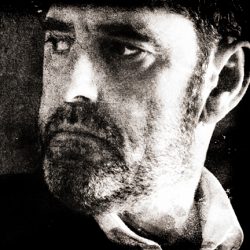
The Anatomy Of A Stroke [Day 4]

As I walked down the ward, there he was, sat up in a high backed chair, his left arm draped across a pillow on a large tray clipped into the chair – the whole scene taking on a curious time lapse quality that had seemingly taken him back to childhood. The team had put him in the chair using a hoist and a complex series of movement restricting straps.

‘Show him what you can do with your leg, Alan,’ said Jo. Dad somewhat theatrically waves his right leg in mid-air, the surgical gown riding up like a can-can girl from the Carnival of Freaks. ‘Not that one!’ He was smiling, his eyes and face already notably brighter than yesterday.

“I’m going to take a penalty*,” he said. I looked down, his face a picture of contorted focus… nothing. Then, after a handful of seconds that hung in the air like an hour, his left leg sharply snapped out and back from the knee; a sudden spike of electricity. “Oh, bugger… I missed.” Smiles all around, none of them broader than that belonging to my step-mother, eyes now welling with happier tears, sat a few feet away. We were all hugely encouraged, but this was still only the beginning of the long road ahead.

I had to hear the slightly disconnected story of being meticulously restrained in the hoist that had landed him in the chair. “I thought they were strapping me into a parachute and putting me in a bomber over Germany.”

My dad. Alan. He was born in 1933, in Bristol: due to it’s aircraft industry, one of the cities notoriously blitzed during the course of the Second World War. I know the experience had a profound affect on him as a child, but it’s not something he really talks about. He spent his entire working life at the BAC [the British Aircraft Corporation]; mostly as a gifted toolmaker, and in his later years, with flight operations. One of his tasks… packing parachutes. He’s never jumped out of a plane, though, with or without one… until now.
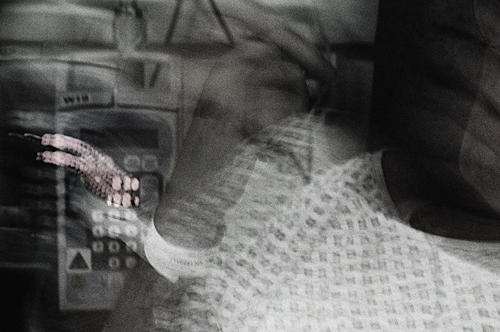
The Anatomy Of A Stroke [Day 3]

My father appears to have discovered the secret of one hand clapping.

I stared at him quizzically. He knew I was there, but he was somewhere in his own world, flickering his hand back and forth, sometimes slowly, sometimes faster, for no apparent purpose yet extremely focussed in his conspicuous task. ‘What are you doing?’ I eventually asked. He laughed his newly lopsided laugh, “I’m clapping.” Meanwhile, his left hand remained entirely motionless, steadfastly refusing to join in the applause. It would seem that in his head he was indeed clapping, but his eyes revealed something entirely different. I say ‘eyes’, but his left, of course, currently another casualty of muscular dysfunction. “Sounds good to me, ” he said, and laughed again.

After yesterday’s lurching sideways shock, it was good to have an important part of him back; lucid again, much brighter in the eyes, yet no longer in hospital: “I’m at the Upton Inn.” A dry sense of humour makes for a strange bedfellow at times like these, but it was genuinely him. And I think he’s going to need the sense of humour in the weeks and months ahead.

My dad. Alan. Now rapidly approaching his 79th birthday. And yet, even with his two hip replacements, an already dodgy arm and a chronic neck problem that was meant to see him attend the pain management clinic early in the New Year… this time last week, he played 8 holes of golf! Moaned about the pain, the freezing weather and his current form, roughly in that order.

The Anatomy Of A Stroke [Day 1]

It began some time around 4am on Monday [19 December] morning. “It was really weird, ” he later told me, “… everything seemed to happen in slow motion.”

My step-mother heard the fall, and found my father, a contortion of awkward limbs on the bathroom floor. Naked, initially he seemed more concerned by the preservation of his dignity than being aware of the relative urgency of dealing with the fire that had been stealthily ignited in his brain.

I received a call a few hours later, still not entirely sure what the situation was. However, when I arrived at A&E that situation was suddenly snapped into sharper focus; clearly no longer the possible issues associated with his chronic neck and arm problems. The fire had been raging deep within the very essence of him. The diagnosis now confirmed as an ischaemic/infarct stroke: a blood clot on the brain.

Although clearly exhausted, I was heartened by his relative lucidity; recalling the moment he’d got out of bed to go to the bathroom and various things that had happened since his admission and in the days before. But now here we were, together, alone, for a seemingly endless few hours, awaiting a bed for admission. He drifted in and out of sleep, occasionally complaining of the pain in his head, and his hip – he has two hip replacements. A man, in his later years, of complex health.

Time crawled, a degree of surreality as the A&E whirled around outside my bubble. Eventually, though, he was admitted to a ward and the dust began to settle on the day. Finally, now more relaxed and comfortable, self-deprecating and dry sense of humour in tact – briefly naked again, surrounded by three nurses, he remarked on the apparent vulnerability regarding their disconcerting use of the word ‘stroke’ – I kissed the soft white hair of his head, he thanked me for everything and I headed home; I was told the next day or two would reveal more.